I'm new to the MMO scene. I've beta tested Guild Wars and The Matrix Online.
I like the dancing (it's my feminine side emerging!). Actually, I like it because it's something I can't do in real life! It's simple: just hit /dance .
Supposedly The Matrix Online provides for interlocked dancing where two people can dance together in a syncronized way. But I haven't found a video of that yet.
2005-02-28

2005-02-27
Color A Dinosaur
www.tallarico.com - Color A Dinosaur
Tommy should know I have two 'l's in my last name. :)
Also, I didn't actually write the Cakewalk->Ascii converter - the fine people at Cakewalk (then Twelve Tone Systems) wrote it. I just had the foresight to order it and figure out how we could use it in games. (It didn't ship with standard Cakewalk.)
And I bet I gave him more than a day to work on it. But probably not a lot more.
Just to put the whole thing in context, the Color a Dinosaur game was made for $50,000.00. That was everything! Heh. I remember we made an exclusive deal with Wal-mart. I think we sold them about 25,000 copies and that was it. It wasn't long before they were about $4.99. (Mario Paint for the SNES was also out at the same time!)
Still, for what it was, it was amazing. Jay Obernolte did in fact code the whole thing while he was going to Cal-Tech. (Jay had also designed hardware for light guns.) It used the bare-minimum chip that Nintendo made.
Ah yes, those were the good old days ...
2005-02-20
3D Me
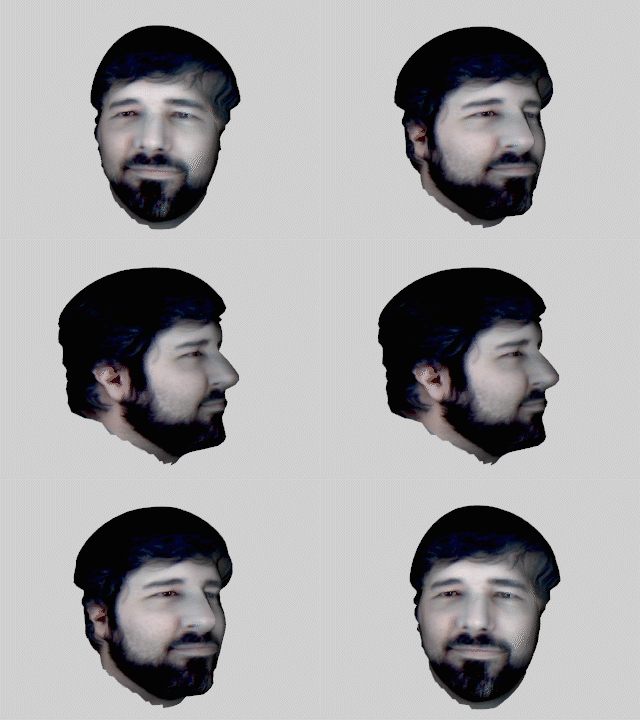
I was lucky enough to get a 3D scan of my face.
Here it is!

© 2005 Stephen Clarke-Willson - All Rights Reserved.
Here it is!
© 2005 Stephen Clarke-Willson - All Rights Reserved.
2005-02-18
Big Difference
I wrote earlier about the question "When does a difference in degree become a difference in kind?"
I think this question applies to Sleep Apnea.
There is something called the AHI or "Apena/Hypopnea Index". It is simply the average number of apnea events per hour added to the average number of hypopnea events per hour.
(Apena events - you stop breathing; Hypopnea events - you breath very shallowly.)
Everyone stops breathing at night (amazingly) and an AHI under five is considered "sub-clinical" or "not interesting."
Some doctors think an AHI over twenty is "very serious" and some think an AHI over thirty is "very serious." My AHI when sleeping on my back without a CPAP machine was over NINETY.
There are stories about people who stop breathing for a minute or two or three at night. In extreme cases these people turn blue from lack of oygen! It puts tremendous stress on the heart and lungs and brain and pretty much the entire system.
But think about it ... if you stop breathing for a minute or two at a time, then the highest your AHI index can be is 60 (you stop breathing for a minute every minute) or 30 (you stop breathing for 120 seconds every two minutes). And that's not really possible because you have to take some time to breath and catch up.
I suspect that if someone stops breathing for two minutes at a time then their AHI index is thirty or lower. The biggest problem for people with a lower AHI is that they suffocate for a couple of minutes repeatedly during the night.
Well, at an AHI of 90, assuming you take time to breathe, you are having an apena event every 40 seconds. Since they last at least 10 seconds you are alternating between breathing and not breathing at a rapid rate, probably every 20 seconds.
Since the way your brain wakes you up is a little shot of adrenaline, that means you have a little shot of adrenaline every 40 seconds all night long.
In fact, my body won't let me fall asleep on my back - I can't go to sleep - I stay awake because my body starts with the adrenline right away! This is true even with the CPAP machine on. Later, after I've been asleep a few hours I can turn onto my back. But not at the start!
On my side the AHI index is 65 and on my tummy the number is unknown. After more research I doubt it is zero. It could be or it could easily be 40. That's still a lot of adrenaline and very little time suffocating.
Which is the long way around of saying that an AHI over 50 or 60 is pretty much a different disease than one where the index is 20-40.
I haven't found any research on this on the Internet. I'm meeting my sleep doctor on Tuesday and I plan to drill him about this. My opinion now is that 'regular' sleep apnea - cases where the AHI is below 30 or maybe 40 - should have one name and cases where the AHI is above 40 should have another name, like Sleep Apnea/Adrenaline Syndrome.
[Note 4/12/2006: my new sleep doctor says that regardless of AHI some portion (20% I think he said) of people with Sleep Apnea simply do not have any symptoms other than snoring and 'snarking' as people call it when you wake up slightly and go back to sleep. He's a good guy - he admits they don't know everything about it.]
© 2005 Stephen Clarke-Willson - All Rights Reserved.
2005-02-11
Google Blogger Fired
It's not such a big deal that one guy was fired because he said too much about internal company stuff on his blog ... but it is a big deal that companies don't generally have blogging standards.
http://redcouch.typepad.com/weblog/2005/02/dinner_with_the.html
http://blog.outer-court.com/archive/2005-02-08-n55.html
An expansive communications policy is pretty important. Game companies, in particular, frequently encourage self-expression by allowing people to decorate their cubes in all kinds of crazy ways. It's easy for an employee to get the idea that such freedom extends in a bi-directional way to the outside world. In some companies that would be fine and in others it would not be fine.
It's all well and good to try to avoid bureacracy by having a minimal set of policies but the fact is people need and want direction and good management supplies it.
Nobody likes to be surprised.
© 2005 Stephen Clarke-Willson - All Rights Reserved.
2005-02-07
802.11n
Here is a PowerPoint Slide Set about 802.11n. I have no idea if it makes any sense separate from the talk, so I will summarize for you.
802.11n is the next big version of Wi-Fi. The main versions so far are
Well, 'n', is a big step forward, and is meant to address all the complaints about the current standards.
The 'n' standard, interestingly, while backward compatible, is tending to support the 'a' frequency range, rather than the much more popular 'b/g' frequency range. Regardless, commercial products will likely be compatible with everything that has gone before.
But enough of that. 'n' has the following amazing features:
Sounds pretty cool!
© 2005 Stephen Clarke-Willson - All Rights Reserved
802.11n is the next big version of Wi-Fi. The main versions so far are
- 'a', which is the 5 Megahertz version, and runs (realistically) at 25 megabits/second;
- 'b', which is the 2.4 Megahertz version deployed in most homes and access points (airports, etc.), and realistically runs 5 megabits/second; and
- 'g', which is the enhanced version of 'b', and runs (realistically) also at 25 megabits / second.
Well, 'n', is a big step forward, and is meant to address all the complaints about the current standards.
The 'n' standard, interestingly, while backward compatible, is tending to support the 'a' frequency range, rather than the much more popular 'b/g' frequency range. Regardless, commercial products will likely be compatible with everything that has gone before.
But enough of that. 'n' has the following amazing features:
- 100 megabits/second transfer rate, reliably, at distances encountered in homes owned by Microsoft millionaires (e.g., 4000 sq ft +);
- capabile of supporting, reliably, 3 simultaneous Hi-Def video streams in a home;
- will be tested in real home and business settings (I suggested they add "kitchens" to the list)
- will support reliable Voice-Over-IP (VOIP) in a home while streaming all that cool Hi-Def video; and
- by the time it comes out in late 2006, will cost about what Wi-Fi costs now, which means chips that "cost the same as a latte."
Sounds pretty cool!
© 2005 Stephen Clarke-Willson - All Rights Reserved
Much more about SpongeBob's gayness.
Much more about SpongeBob's gayness.
I've only watched one episode of SpongeBob and it was the one where they go up on land and the characters are played by silly puppets. It's 'live' action, not animated, and it is hilarious. I think the episode is called "Pressure."
I guess I feel some small connection to SpongeBob because the guy who does his voice did some voice acting on the Samurai Jack video game I worked on. His name is Tom Kenny and in person he is a very funny guy.
2005-02-03
Difference
Capital Vol. I Chapter Eleven:
When it was time to work on my dissertation, one of my faculty advisors, John King, told me to think about "when a difference in degree becomes a difference in kind." He didn't tell me this was a modification of a quote from Marx, who had modified something Hegel wrote.
His example was that a jet isn't just a fast airplane - to make a jet requires different control surfaces, different engines, different shape, different materials - just about everything needs to be re-engineered.
This insight has been hugely beneficial during my career. In the case of the Ada interpreter, it wasn't just a big interpreter for a normally compiled langauge - it evolved into something rather different, because to support Ada as an interpreted language without destroying its usefulness as a compiled language was a rather complex problem.
Later, when I worked on the B-2 Stealth "Spirit" Bomber, I realized that a stealth airplane wasn't just an invisible airplane - everything had to be reworked - materials, control surfaces, shape, engines - even the mission was different from a regular bomber. (My focus when working at the Northrop Research and Technology Center was computer graphics to support the 'new mission' of the B-2.)
When working on video and computer games, which are based on fast-moving computer technology, I have run up against this all the time. Each generation of gaming platform brings with it a whole new set of concerns. The old tools won't cut it - you generally need significantly enhanced or improved tools just to make the game.
Now I am working on an on-line music downloading service, and I can tell you that it's not just a music store without walls.
It's a completely different beast that has required re-engineering the entire model from the ground up.
Cool beans!
When I was in college I was working on an Ada interpreter. Ada was the new DoD 'official' language for embedded systems. Ada was a compiled language so an interpreter was an interesting idea."Here, as in natural science, is shown the correctness of the law discovered by Hegel (in his Logic), that merely quantitative differences beyond a certain point pass into qualitative changes."
When it was time to work on my dissertation, one of my faculty advisors, John King, told me to think about "when a difference in degree becomes a difference in kind." He didn't tell me this was a modification of a quote from Marx, who had modified something Hegel wrote.
His example was that a jet isn't just a fast airplane - to make a jet requires different control surfaces, different engines, different shape, different materials - just about everything needs to be re-engineered.
This insight has been hugely beneficial during my career. In the case of the Ada interpreter, it wasn't just a big interpreter for a normally compiled langauge - it evolved into something rather different, because to support Ada as an interpreted language without destroying its usefulness as a compiled language was a rather complex problem.
Later, when I worked on the B-2 Stealth "Spirit" Bomber, I realized that a stealth airplane wasn't just an invisible airplane - everything had to be reworked - materials, control surfaces, shape, engines - even the mission was different from a regular bomber. (My focus when working at the Northrop Research and Technology Center was computer graphics to support the 'new mission' of the B-2.)
When working on video and computer games, which are based on fast-moving computer technology, I have run up against this all the time. Each generation of gaming platform brings with it a whole new set of concerns. The old tools won't cut it - you generally need significantly enhanced or improved tools just to make the game.
Now I am working on an on-line music downloading service, and I can tell you that it's not just a music store without walls.
It's a completely different beast that has required re-engineering the entire model from the ground up.
Cool beans!
Zero
So I'm at the "durable homecare equipment" (DRE) provider converting my CPAP rental into an auto-adjusting CPAP sale. And I'm talking to the very nice CPAP specialist person there and I'm telling her that I think that if I sleep a certain way than my sleep apnea is vastly reduced even without the machine. And she says, ...
"Oh yeah, belly sleepers don't register sleep apnea. In sleep studies they make you sleep on your back or on your side otherwise they don't get a reading."
"But ...," I say, "Shouldn't they measure a person in their normal sleeping mode?"
"Yes, but then they don't get numbers - people don't have sleep apnea sleeping on their tummies."
"But ...," I say, "Why don't they tell you that, so that people will sleep on their stomachs and avoid a potentially life-threatening disease?"
"I don't know. They should."
I remember when I was first diagnosed and I was waiting for my machine. I called the nurse that works with my doctor and I asked (via her answering machine), "Is there any sleep position I can sleep in while I'm waiting for my machine that is better for me?" (I had read on the web that sleeping on your side is better but I wanted to check it out with the nurse.) I never heard back.
I knew I had sleep apnea - my wife heard it at night. But I also knew that I “managed” the severity of it because of the way I slept. My weight is too high which is a symptom. But my blood pressure is very good, and my cholesterol is border-line, which is not bad, and my daytime sleepiness was not that bad (it would come and go). So I knew I was doing something that improved my situation.
When the CPAP specialist confirmed that it was possible to “manage” your sleep apnea simply by sleeping in a different position I felt pretty ripped-off. Not by her but by the entire sleep diagnosis system.
Now, months later, my machine is working well enough that if I have caffeine I start to get jittery right away. It's been a nightmare of self-diagnosis and making myself into a guinea pig to get the CPAP treatment to work. It is better to use the machine once you have adapted which can be very hard. But especially for people like me where the apnea is quite severe - 90+ events per hour when I'm on my back - it would be really good to know that if I'm traveling or I just fall asleep somewhere that I can sleep on my tummy and get a decent sleep.
In my case, the whole adrenaline withdrawal thing (which I suspect is a pattern with people with really severe sleep apnea, and the main reason they don't adapt to CPAP) was a whole 'nother nightmare. I took Doxepin to knock back the itchiness that was masked by my elevated adrenaline levels, and the final bit of adaptation was that I just put the machine on at night, and then the first time I woke up, I took it off, and got my normal crappy sleep, which included a certain amount of adrenaline boosting through the night. First I lasted two hours, then three, then four, then five, then six, then seven, then eight, then nine. I still need more than eight hours sleep but I don’t think that will be true for long.
In this way, I was slowly able to wean myself off the adrenaline. Adrenaline withdrawal is WAY more difficult to deal with than caffeine withdrawal.
I tried to call the nurse practitioner at the sleep center to ask for more information on adrenaline withdrawal yesterday because he is the only person who ever mentioned that to me. I can't find anything about it on the web. Maybe it's not even a real thing although it explains my situation rather well. But he's not working at the sleep center anymore.
*Sigh*.
I have a follow-up appointment with my doctor in a few weeks - it takes 4-6 weeks to get in to see him. Hopefully he'll know something about this adrenaline withdrawal thing.
But I guess it doesn't matter. I've pretty well licked it.
But the whole sleep apnea diagnosis and treatment process has been a cluster-fuck and if I hadn't put a lot of energy into this I would have been really screwed up.
You can see why some people don't like doctors and turn to any alternative they can find that sounds like it might be more pleasent than going to the doctor.
*Double Sigh*.
In the meantime – if you or your wife thinks you have sleep apnea and you can’t talk yourself into going into the sleep center (especially after reading this!) – sleep on your tummy.
© 2005 Stephen Clarke-Willson - All Rights Reserved.
2005-02-02
"Email Address Space"
It occured to me, while I was working on the registration component of the downloadable music service I am working on, that so much of the web is based around your email address.
And it occured to me that web services like Hotmail and Yahoo can never retire your email address.
Sure, they say, they will discontinue your email service if you don't login for a long time. Maybe they do. But I doubt they delete your email address from their database and make it available to anyone else.
Businesses can and do recycle email addresses. Bob works for the company when it is small, leaves, his email is deleted, and then another Bob joins. Odds are, the new Bob will get the old Bob's email address.
Who knows what the old Bob might have signed up for? Who knows what might show up in the new Bob's email box?
Maybe businesses shouldn't recycle email addresses. Maybe, like famous jersey numbers, email addresses should always be issued one time to one person.
A person can always give his email address away to someone else. But I suspect Yahoo or Hotmail knows that nothing good can result from recycling email addresses and so they don't.
I recently signed up for X-Drive. X-Drive is an online disk service that you can use for backups for sharing. I had originally signed up for X-Drive many moons ago during the Internet Bubble.
X-Drive still remembered me, based on my email address, even though it had totally transformed over the years into a pay service. Imagine if some random person's email address was recycled by Hotmail or Yahoo and given to me. I go to X-Drive, naively believing it has never heard of me, and I can't register because "that name is taken" - the previous owner of the email address is still registered at X-Drive. So I ask X-Drive to send me the password. Now I have access to the previous person's account.
That doesn't seem so good.
So, I suspect that if it was possible somehow to plot the density of "Email Address Space" it would never contract and would always expand, because smart email hosting companies would never recycle an old email address. If the original owner stopped using it, then that would be the end of the line for that email address, never to see the light of electronic bits flying through Cyberspace again.
© 2005 Stephen Clarke-Willson - All Rights Reserved.
2005-02-01
Johnny Carson / Steve Whitehill
Johnny Carson passed away recently, as you know. His passing reminded me of the time I went to see The Tonight Show taping at NBC in Burbank. I went with my friend Steve Whitehill who, sadly, also passed away recently. Even though I hadn't seen Steve Whitehill for at least 10 years I was greatly saddened at his passing.
I wrote the following note which Eric Olsen read at Steve's memorial:
© 2005 Stephen Clarke-Willson - All Rights Reserved.
I wrote the following note which Eric Olsen read at Steve's memorial:
Hello everyone. Thank you, Eric, for reading this for me.
My name is Steve Willson and I was good friends with Steve Whitehill while we both went to graduate school. We probably spent 8 or 10 hours a day together, five or six days a week, for years, working on the computer systems at UCI.
I learned a lot about programming from Steve. I remember that we would get stuck on a problem and Steve would get out his notepad, draw a few boxes and arrows, and make everything clear. We did a lot of what is known today as “pair programming,” where one person would look on while the other “drove” the computer terminal – and then we would switch roles every few hours.
In all those hours together I learned to laugh a lot. We would both sign up for concerts, hoping to get a date, and rarely get one, so we wound up going together. I remember we went to see Rodney Dangerfield at the Dorothy Chandler Pavilion. Steve was always doing Rodney Dangerfield impersonations.
We would stay up late at the ICS lab at UCI. There was a really old black and white TV there that barely got any reception. We strung a big wire around the room so we could watch and listen to The Tonight Show with Johnny Carson while we programmed late at night. Eric was there a lot too, working on his compiler class.
Steve enriched my experience at UCI so much. I spent so many hours at UCI while working on various degrees that I think I would have gone insane without Steve’s friendship and great sense of humor.
Toward the end of graduate school, we both met the women who would be our future wives, and we drifted apart. But Steve’s spirit and good humor stays with me to this day, 25+ years later, and will for the rest of my life.
God Bless Steve Whitehill and let me express my warmest condolences to his family.
Thank you.
© 2005 Stephen Clarke-Willson - All Rights Reserved.
2005-01-29
Only Child
People who know me assume I am an only child, since I never talk about my old family, or as some call it, my birth family. (The 'old' family is in contrast to my 'new' family - that is, my current family, which is to say, my wife and kids. I first mentioned my old family here.)
In fact, I have a sister Marilyn, who is seven years older than me, a brother Tom, who is five years older than me, and a brother Tim, who is about two years younger than me. My mother passed away and my father remarried a woman I have never met.
The only person I talk to is my brother Tom. It's not so much that I dislike the other people in my family as that it is really hard to talk to them since the basis of their world is that evil is an illusion and I don't share that view. How can you have a conversation with people that don't believe that anything bad ever really happens?
I have piles of cousins, but I never see them.
I first discovered that my Dad had remarried when I received mail from a woman named Susan who said she was cleaning out some old things and came across some pictures of me as a kid.
I wrote to my brother Tom: "Who the hell is Susan?"
The answer: Dad's new wife. Wow.
I learned that my grandmother on my father's side had passed away when I was talking to my sister. This was a long time ago. We were chatting and she said, "Oh, by the way, Grandma died." I had to ask - why didn't Mom or Dad tell me? "Oh, they were busy getting ready for a trip to Hawaii."
So, you can tell, it's not too surprising that I don't talk to these people. I can talk to Tom, because he believes in physical reality, so we have a basis for conversation.
Speaking of which, my brother Tom, like me, is a very early on blogger. When both of us started writing online there was no such thing called a blog, but going by the current definition ("a web site with dated entries"), we both have been doing it for close to ten years I think.
My brother's is in a very original format. Part of it takes the form of an online trading forum where people trade futures in things like ego, denial, greed, humor, paranoia, and what not. There is another section where he posts longer essays (with dates, which makes them blog entries).
Tom's site is called Salmon Jack and here it is. It's Java based, so you need a Java runtime system installed.
© 2005 Stephen Clarke-Willson - All Rights Reserved.
2005-01-28
Cardboard computer

This is a cardboard implementation of a Digicomp I computer created by a person known only as "Sven". I came across this on a Yahoo group dedicated to the Digicomp I computer, which came out in 1966 or so.
The Digicomp I computer was a plastic computer that I was given when I was in third or fourth grade. My parents bought one for me (I can only believe that a teacher at school asked them to, since they had no interest in computers.)
The original Digicomp I is a collector's item now, fetching up to $450.00 on eBay.
The computer is "cycling" and performing some kind of logic in the animation. The Digicomp I had three bits in an ALU (Arithmetic/Logic Unit) and could count from 0 to 7 or simulate a traffic-light and that sort of thing. I learned Boolean algebra and about Venn diagrams and that kind of stuff
I spent the summer inside the house every day playing with it. I was about eight or nine at the time. My parents were quite distressed. "Go outside more!" I remember I had the soundtrack to Chitty-Chitty Bang Bang going in the background the entire summer. The record player just looped through it all day.
More stuff about the Digicomp I is here. The Yahoo group is "Friends of Digicomp".
(BTW, in real life you "cycled" the logic by moving the slide on the lower right of the animation. This is a stop-motion animation of the computer working.)
[Wait! There's more!]
And here is one made out of K'Nex.
Text © 2005 Stephen Clarke-Willson - All Rights Reserved
2005-01-25
Stephen Sez
Somebody's idea of me as a game producer:

It was probably mostly Al Eufrasio but I think some other people contributed.
© 2005 Stephen Clarke-Willson - All Rights Reserved.
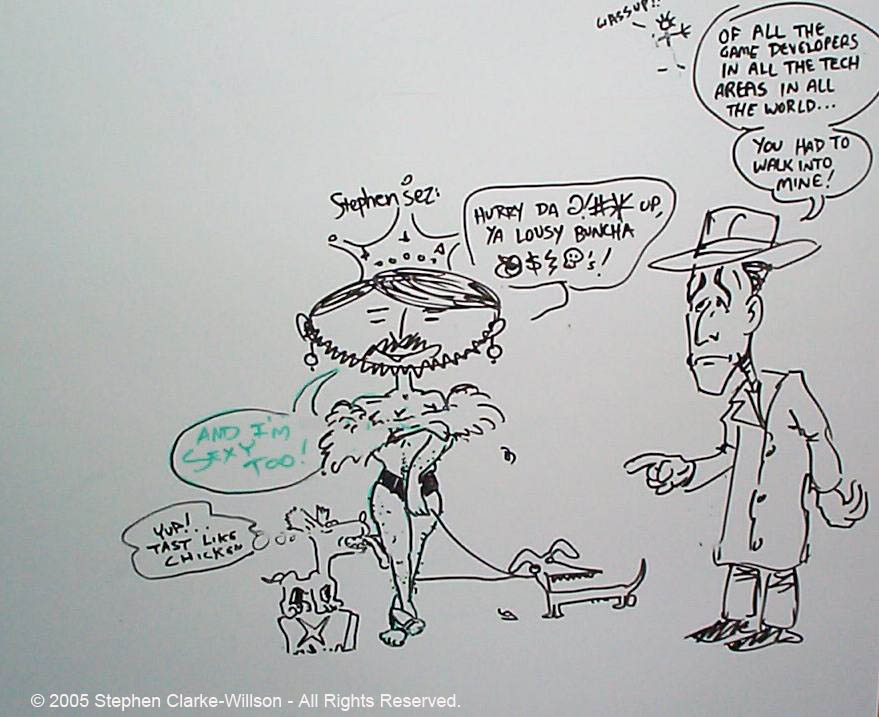
It was probably mostly Al Eufrasio but I think some other people contributed.
© 2005 Stephen Clarke-Willson - All Rights Reserved.
2005-01-23
Christian Science
Christian Science by Mark Twain.
I was raised a Christian Scientist.
Yes, that is an oxymoron.
I was taught that the world - the material world - is not real, but an illusion.
I could live with that - lots of smart people (Plato comes to mind) have thought that over the centuries.
The part of Christian Science that drove me crazy was that the idea that the illusion was an illusion too and was in fact an impossiblity, and that by realizing that, any disease would instantly vanish.
If that makes any sense to you, by the way, then your ability to hold opposing concepts in your mind simultaneously is very well developed. Or you are crazy - more likely the latter case.
Various attempts at healing me over the years were failures. For instance, I got Chicken Pox as a kid. After much praying, it went away over the same time period as for everyone else that had Chicken Pox and didn't do a lot of praying.
I had acne in high school. I went to a "practitioner" - that's a person that can see the Truth with a capital T in spite of the supposedly non-existent illusion that surrounds us. I went once or twice a week for a year or two.
Eventually my acne cleared up, at about the same rate as for other kids that had acne like mine and didn't go to a practitioner once or twice a week for a year.
Most disappointing, on the practitioner front, was that my practitioner was really fat and the wife of another practitioner who later went on to become the president of the Mother Church in Boston. So these were supposed to be really whiz-bang practitioners.
The link is to a book by Mark Twain who had some choice comments to make about Christian Science. In particular, Mark Twain says that Science and Health with Key to the Scriptures by Mary Baker Eddy was so massively edited as to become another work not really written by Mary Baker Eddy.
There are also stories that Mrs. Eddy stole the original idea from a guy named Phineas Quimby which I personally believe. As the work (Science and Health) was modified and edited it came to make less and less sense - not that Quimby’s stuff made a lot of sense to begin with. Still, he at least stuck to his guns – that the world is an illusion – a dream (or a nightmare) – that we can modify any time we want if we would only realize our power to do so. Mrs. Eddy had to go a step further and say that the illusion could never exist. Somehow realizing the illusion was an illusion that couldn't exist would be the truth that sets you free.
I can tell you it is very hard to grow up in a family that doesn’t believe in physical reality. It’s a perfect environment for the most horrific denial. Anything that goes wrong is just an “error in perception” and should be denied and cast out with great forcefulness. And if that doesn’t fix things, then you didn’t do it right, so repeat until you get it right.
I gave it all up when I was about 22. My older brother Tom gave it up too. My younger brother Tim believes in it in spite of a knee injury that has never healed. My father still believes it even though his wife (my mother) of many years died a miserable and horrific death from cancer which remained untreated until she wasted away over a period of a year and a half. My older sister Marilyn still believes in it even though her husband felt a little strange at dinner one night and died within a few minutes.
Overall, Christian Science is a shrinking religion, primarily because members of the church have a good chance of dying from a lack of proper medical care.
To be sure, there is truth in Christian Science. Not every ailment needs a doctor. If people would just calm down then about 1/3 to 1/2 of all disease would vanish.
But it is that other 2/3rds or 1/2 that can kill you.
It’s important to distinguish between the stuff that your mind – your brain – which is the largest generator of chemicals and hormones and what-not in your body – is screwing up – and the genuinely physiological problems; it is diagnosing the difference that requires true skill.
As for me, I am left with a deep sense of the mystery of life. I believe there is much more to the world than what we can sense directly. I believe there are principles that guide the universe. I'm with Einstein - the amazing thing isn't that there are principles that guide the universe - the amazing thing is that we can understand them.
And deep down I believe reality is an illusion - but an extremely detailed and very powerful one - and if one loses one's respect for reality then one is going to suffer the consequences.
© 2005 Stephen Clarke-Willson - All Rights Reserved.
Sony admits proprietary standard was a mistake
As I mentioned before, Sony blew it by endorsing their own proprietary standard that implemented SDMI - an annoying copy protection scheme.
Now an executive at Sony (Ken Kutaragi) has admitted as much. This is a bit historic, as Sony doesn't normally own up to mistakes.
Ken Kutaragi is some kind of genius - he's done a lot of things right in the video game world. Everybody hates the hardware of the PS2 though - it's basically the Cray architecture implemented for video games. Ken thinks it is cool to take the space normally reserved for fast memory on a computer chip and replace it with vector processing.
Well, to my way of thinking, there is a reason nobody uses the Cray system architecture anymore - it's better to use that chip space for fast cache memory. And programming all of those vector units is a pain in the ass. The PS3 is going to be like the PS2 except 10 times more annoying.
© 2004 Stephen Clarke-Willson - All Rights Reserved.
2005-01-22
Another Disneyland Knock-Off
Miceage.com: Another creepy Disneyland knock-off - this one is in Japan. (Scroll down the page to get to the Nara park.)
Also, the article mentions roller coaster videos by Robb Alvey. Robb and I worked together at Virgin Interactive. Robb introduced me to the Sherman Bros who wrote so many of those great Disney songs. We took the Shermans out to lunch at South Coast Plaza. One of them does all the talking while the other one sits in the background and ruminates. I don't collect autographs as a matter of course but I managed to get them to autograph my Mary Poppins DVD.
(I think Mary Poppins is easily one of the greatest movies ever made. Yes, I know, it's not 'serious' or 'important' like Lawrence of Arabia, another great movie, but it's still great nonetheless.)
2005-01-19
Abandoned
We were considering last summer what to do with the rather large wasp nest in our front yard. Should we fill it full of poisonous gas? Knock the thing down and run like heck?
After some research on the all mighty internet we discovered that Wasps create a nest, lay eggs and raise their children, and then split! We decided to leave the Wasps alone primarily because they were leaving us alone and we thought it was probably better for the gene pool to allow less aggressive Wasps to breed.
One day late in the fall I was out mowing the lawn and it dawned on me there was no activity at the Wasp nest. Indeed, as predicted, the Wasps had left, and the nest, which was no longer actively maintained, was falling apart.

We don't know where the Wasps went. Our only guess is that they moved to the suburbs as many WASPS do.
© 2005 Stephen Clarke-Willson - All Rights Reserved.
After some research on the all mighty internet we discovered that Wasps create a nest, lay eggs and raise their children, and then split! We decided to leave the Wasps alone primarily because they were leaving us alone and we thought it was probably better for the gene pool to allow less aggressive Wasps to breed.
One day late in the fall I was out mowing the lawn and it dawned on me there was no activity at the Wasp nest. Indeed, as predicted, the Wasps had left, and the nest, which was no longer actively maintained, was falling apart.

We don't know where the Wasps went. Our only guess is that they moved to the suburbs as many WASPS do.
© 2005 Stephen Clarke-Willson - All Rights Reserved.
2005-01-17
ARP
This is me (25 years ago) with my ARP synthesizer. All things considered, it was a piece of crap, but it was loads of fun to play with. It was a load of crap because none of the components in it would stay in tune for more than 10 seconds.

I haven't fooled with synthesized music for about five years or so, but here is some electronic music I composed sometime in the last ten or fifteen years.
© 2005 Stephen Clarke-Willson - All Rights Reserved.
I haven't fooled with synthesized music for about five years or so, but here is some electronic music I composed sometime in the last ten or fifteen years.
© 2005 Stephen Clarke-Willson - All Rights Reserved.
Stage Show
I love playing ragtime piano.

This is me playing at "The Stage Show", a show my old high school, Corona Del Mar, would put on every other year. I taught myself to play by watching Rod Miller at Coke Corner at Disneyland every weekend for two years and then going home and practicing for a couple of hours. Plus, like Rod, I bought a player piano that I could slow down or even stop to learn the notes.
More about that, and sample music is here.
© 2005 Stephen Clarke-Willson - All Rights Reserved.
Subscribe to:
Posts (Atom)